How to Choose a Pillow for Your Sleep Position – and When to Replace It

The short answerHow do you choose a pillow? By your sleep position. Side sleepers need a high, stable pillow that fills the gap between ear and shoulder, back sleepers need a medium height with support in the curve of the neck, and stomach sleepers need a very low, soft pillow. The guiding rule: your neck continues the line of your back. Replace your pillow when it sags, gets lumpy or doesn't spring back into shape.
In brief
- Side sleepers – a high, stable pillow, ideally with a pillow between the knees.
- Back sleepers – medium height and support in the curve of the neck.
- Stomach sleepers – a very low pillow or no pillow at all.
- A pillow that sags, gets lumpy or doesn't unfold after being folded – time to replace it.
How do you choose a pillow for your sleep position?
Choose a pillow based on the gap it needs to fill between your head and the mattress. The bigger that gap, the higher and more supportive the pillow needs to be. The goal is for your neck to continue the line of your back without bending up or dropping down.
A simple test: lie in your usual position and ask someone to look at you from the side. If your chin is pushed toward your chest, the pillow is too high. If your head tilts toward the mattress, it's too low.
Side sleepers
Side sleepers need the highest, most stable pillow, because it fills the gap between your ear and the edge of your shoulder. A pillow that's too soft sinks during the night, and your neck bends sideways. Look for a height that suits the width of your shoulders and a fill that holds its shape.
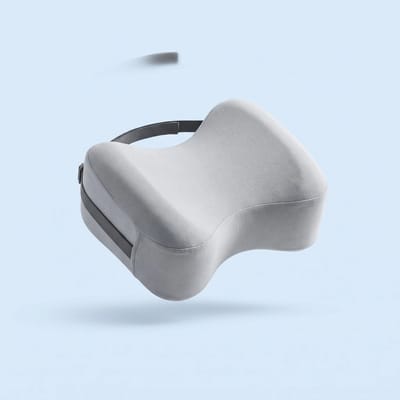
Many side sleepers feel more comfortable with an extra pillow between their knees. It keeps the hips parallel and reduces twisting of the pelvis and lower back.
Back sleepers
Back sleepers need a medium-height pillow that mainly supports the curve of the neck and doesn't push the head forward. A pillow that's too thick makes your chin drop to your chest. Pillows with a contour under the neck suit many people in this position.
Stomach sleepers
Stomach sleepers need a very low, soft pillow, and sometimes you can skip it altogether. In this position your head is turned to the side for hours, and a high pillow only increases the angle. If you're trying to get used to sleeping on your side, a body pillow to hug can help with the transition.
Table: which pillow suits which position?
| Sleep position | Recommended height | What to look for | Worth adding |
|---|---|---|---|
| Side | High, based on shoulder width | A stable fill that doesn't sink | A pillow between the knees |
| Back | Medium | Support in the curve of the neck | A small pillow under the knees |
| Stomach | Very low or no pillow | Softness and minimal height | A body pillow to help shift to side sleeping |
| Combination | Adjustable | The option to change height and softness | Testing over a few nights |
What's the difference between a regular, foam and adjustable pillow?
The main difference is how well the pillow holds its shape and how much you can adapt it to you. A regular fiber pillow is pleasant and soft, but tends to flatten over time. An ergonomic foam pillow keeps a fixed shape – for example XNEEX CervaCurve™, an ergonomic foam neck pillow.
If you're not sure what height suits you, or you change positions during the night, an adjustable pillow gives you more room for trial and error, since you can fine-tune the height and softness gradually until it feels right. You can compare the pillows we offer in our Neck & Sleep collection.
When should you replace your pillow?
Replace your pillow when it no longer springs back into shape, when it has lumps, or when you're waking up with a stiffer neck than before. There's no single date that suits everyone, because it depends on the type of fill and how much it's used.
Signs it's time to check:
- You folded the pillow in half and it didn't unfold on its own.
- You fold it or add another pillow to get a comfortable height.
- It has a permanent dip where your head rests.
- The fill bunches up at the sides and leaves a thin area in the middle.
- You sleep better on a different pillow, for example at a hotel.
It's also a good idea to wash or air your pillow according to the manufacturer's instructions and use a protective cover. That keeps it pleasant and fresh for longer.
How do you get used to a new pillow?
Give a new pillow a few nights before you decide. Your body is used to the old position, even if it wasn't comfortable, so the first few nights can feel strange.
- Start at the lowest setting, if the pillow is adjustable.
- Change one thing at a time: height or softness, not both together.
- Notice how you feel in the morning, not just when you fall asleep.
- Check your mattress too: a very soft mattress lets your shoulder sink and changes the height you need.
If you're unsure, email us at hello@getxneex.com – real people will reply – and you have 30 days to return. You can see all the options in the Neck & Sleep collection.
What else affects your neck at night?
Your pillow is only part of the picture. Hours in front of screens, sitting hunched over and reading your phone in bed affect how your neck feels just as much. We cover this in more depth in our neck and sleep guide.
Side sleepers who feel strain in their lower back can try XNEEX SleepAlign™, an orthopedic knee pillow for side sleepers, together with a head pillow at the right height.
Frequently asked questions
What's the best pillow for side sleepers?
Side sleepers do best with a high, stable pillow whose height matches the distance between the ear and the edge of the shoulder. The fill should hold its shape through the night so your neck doesn't bend sideways. Many side sleepers also add a pillow between their knees for a more comfortable alignment.
How often should I replace my pillow?
There's no single number for every pillow, because it depends on the type of fill and how it's used. Replace your pillow when it doesn't spring back after being folded, has lumps or a permanent dip, or when you need to fold it or add another pillow to feel comfortable.
How do I know if my pillow is too high?
Lie in your usual position and ask someone to look at you from the side. If your chin is pushed toward your chest when lying on your back, or your head is raised above the line of your back when lying on your side, the pillow is too high. A stretched feeling on the side of your neck in the morning can also be a hint.
Is an adjustable pillow worth it?
An adjustable pillow is especially good if you're not sure what height you need, or if you change positions during the night. It lets you change height, softness and support gradually, so you can find the right feel without buying several different pillows.
How long does it take to get used to a new pillow?
It usually takes a few nights for your body to adjust to a new position, even if it's a better one. Change one setting at a time, pay attention to how you feel in the morning and not just when falling asleep, and don't judge the pillow by the first night.
More from the Knowledge Center
The neck and sleep guide: neck tension, screens and pillows →Neck stretching at home – how to do it right and safely →Long hours of sitting and your back: quick moves you can do at your desk →All articles →This article is general information and is not a substitute for medical advice.