How to Lift Heavy Things Without Straining Your Back: The Right Technique at Home and at Work

The short answerLifting in a way that protects your back comes down to a few simple rules: get close to the object, stand with your feet hip-width apart, bend at your knees and hips instead of rounding your back, hold the load close to your body, and lift with your legs without twisting your torso. Turn with your feet, not your back. If the object is heavy, bulky or unstable – split it up, use a cart or ask for help.
In brief
- Close to your body is easier on your back: the farther away the load, the harder your back works.
- Bend at your knees and hips, keep your back long, and lift with your legs.
- Don't twist with a load in your hands – move your feet and turn your whole body.
- Heavy or awkward object? Split it up, wheel it on a cart or lift it with two people.
Why does lifting correctly matter for your back?
Lifting correctly spreads the effort across your legs, glutes and core instead of loading everything onto your lower back. When you bend over with a rounded back and straight legs, and lift something far from your body, your back does most of the work.
Most "my back went" moments after lifting don't come from the heaviest object, but from lifting quickly, twisting mid-movement or being tired at the end of the day. That's why technique matters even when you're lifting a laundry basket, not just a heavy box.
How do I lift correctly, step by step?
The basic technique works for almost any lift from the floor: get close, bend with your legs, hold it close and rise slowly. Here are the steps:
- Test the load: try moving it a little before you lift, to get a sense of how heavy it is and whether the contents shift inside.
- Get close: stand right next to the object, feet hip-width apart, one foot slightly in front of the other for stability.
- Bend at your hips and knees: your hips move back, your knees bend, and your back stays long – not necessarily fully upright, but not rounded.
- Get a good grip: with both hands, a secure hold, ideally on the handles or the bottom of the box.
- Brace your core and breathe: tighten your stomach muscles slightly before you start, without holding your breath for long.
- Rise with your legs: push into the floor and straighten your knees and hips together, in one smooth movement rather than a jerk.
- Keep it close: the load stays near your stomach the whole time you're walking.
- Set it down the same way: bend with your legs again, and don't "drop" the object down.
What should I avoid while lifting?
The common mistakes are easy to spot, and you can fix most of them on your very next lift.
| Instead of... | Better to... |
|---|---|
| Bending with straight legs and a rounded back | Bend your knees and hips and keep your back long |
| Holding the load far from your body | Hold it close to your stomach |
| Twisting your torso with the load in your hands | Move your feet and turn your whole body |
| Lifting something heavy over your head | Use a sturdy step stool or ask for help |
| Carrying everything in one go | Split it into a few lighter trips |
| Lifting first thing after getting up or at the end of an exhausting day | Warm up a little first, or put off the heavy lifting |
How do I lift correctly at home?
At home you lift all day without noticing: groceries, laundry, kids, plant pots. A few small changes make a difference.
- Grocery bags: split the weight evenly between both hands – a few short trips are better than one heavy one.
- Laundry basket: put it on a chair or the washing machine instead of the floor, so you bend less.
- Lifting a child: crouch down to their level, hold them close and rise with your legs. From a crib or the car – get as close as you can before lifting.
- Dishwasher and fridge: for low items, kneel on one knee instead of bending from your back.
- Moving furniture: push rather than pull, ideally using furniture sliders or a second person.
How do I lift correctly at work?
In physical work, in a warehouse or a store, lifting is repeated over and over, so fatigue plays a big role. Use the carts and lifting aids available, store heavy items at waist height, and take short breaks. If you work sitting down and get up to lift something, take a moment to move first. You'll find ideas for quick moves in our article Sitting for long hours and your back.
How do I build a long-back habit in everyday life?
Good lifting technique relies on posture awareness in the moments between lifts, too. If you're used to slouching and bending from your back, you'll go back to that when you lift a box.
The PosturePro posture trainer is a small sensor that sticks to your upper back with adhesive pads, and you calibrate it with one press while sitting upright. When your body slumps or leans forward, it vibrates gently – a quiet reminder to straighten up. You can adjust the sensitivity, and we recommend starting with about 30 minutes a day and building up gradually. It's not suitable for people with adhesive sensitivity or a pacemaker. More about it in our article Posture trainer.
At the end of a busy day, the BackWave massage cushion sits on the back of your chair at lower-back height, with shiatsu massage, heat and vibration, for 15–20 minutes of relaxation. It's not suitable during pregnancy, with a pacemaker, on damaged skin or on a fresh injury. You'll find both products in the Back collection, and for questions, email us at hello@getxneex.com.

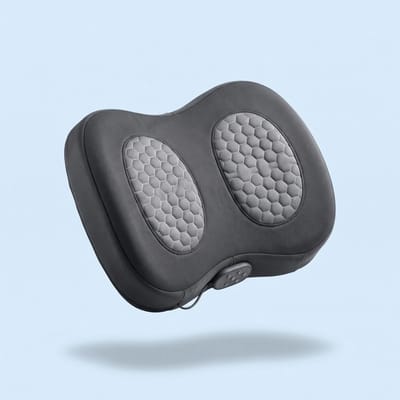
XNEEX BackWave™ – Back Massage Cushion with Heat and Vibration
See the massage cushionFrequently asked questions
Do I need to keep my back completely straight when lifting?
Your back doesn't have to be fully upright. The goal is a long back that isn't rounded, with the bend coming from your hips and knees. A torso tilted slightly forward with a long back is a natural position when lifting from the floor. What you want to avoid is sharply rounding your lower back while your legs stay straight.
How do I lift a child without straining my back?
Get as close to the child as you can, crouch or bend at your knees, hold them close to your body and rise with your legs. From the car, lean in closer instead of reaching far with your arms. With the child in your arms, turn with your feet rather than your torso, and switch arms so you don't load one side.
What's the maximum weight I can lift?
There's no single number that suits everyone. It depends on your strength, fitness, the size of the object and the state of your back. A good rule of thumb: if you're not sure you can lift and carry the object under control, without holding your breath and without rounding your back, it's too heavy to lift alone – split it up, use a cart or ask for help.
Why does my back go when I lift something light?
Often it's not the weight of the object but the movement: bending quickly with a rounded back, twisting mid-lift, or being tired at the end of the day. Getting out of bed and lifting right away is also felt more. That's why it's worth using the right technique for light objects too, not just heavy boxes.
Does a posture trainer help you lift correctly?
A posture trainer like PosturePro doesn't lift for you, but it gives you a gentle vibrating reminder when your body slumps or leans forward. That way it can help you build posture awareness throughout the day, and that awareness stays with you when you bend down to lift something.
More from the Knowledge Center
Sitting for long hours and your back: quick moves you can do at your deskPosture trainer: how it works and how to build an upright sitting habitStiff back and tired muscles: a guide to what helps at home and at workAll articles →This article is general information and is not a substitute for medical advice.