Work Shoes for Standing All Day: How to Choose Shoes and Insoles for a Long Shift

The short answerWork shoes for standing all day should combine four things: a roomy toe box, a stable heel that doesn't collapse, a sole with cushioning and grip, and a removable insole. Try shoes on at the end of the day, with the socks you wear to work, and check that they're comfortable from the very first moment. A cushioned insole and graduated compression socks can complete the shoe for a long day on your feet.
In brief
- A good shoe for standing is wide at the front, stable at the back and cushioned underneath.
- Try shoes on in the afternoon, with your work socks, on both feet.
- A cushioned insole adds a layer of comfort when the shoe's original insole is thin or worn.
- Graduated compression socks go on in the morning and come off before bed.
What makes work shoes for standing truly comfortable?
A comfortable shoe for long hours of standing is one your feet don't notice after a few hours. It gives your foot room, keeps your heel stable and cushions the contact with the floor.
Anyone who works in a kitchen, a store, a warehouse, a hospital or behind a counter knows the problem doesn't start in the morning. It builds up. That's why it's worth choosing work shoes by how they feel in hour eight, not just in the first minute in the store.
What to check in a shoe before you buy
There are five things worth checking in any work shoe, whatever the type or style.
- Wide toe box: your toes should move freely, without being squeezed together.
- Stable heel: press on the back of the shoe. If it folds easily, your heel will move around inside it all day.
- Cushioned sole: a thin, hard sole sends every step straight to your foot.
- Grip: in a kitchen, a hospital or anywhere with wet floors, a non-slip sole is part of comfort.
- Removable insole: a shoe with a removable insole lets you swap in a different one when needed.
What about high heels or completely flat shoes?
For long hours of standing, it's best to avoid both extremes. High heels shift weight forward onto the ball of the foot, and a completely flat shoe with no cushioning leaves your foot without a layer of comfort against a hard floor.
How to try on work shoes correctly
Try shoes on in the afternoon or at the end of the day, when your feet tend to be wider than in the morning. That way the shoe will also fit during the last hours of your shift.
- Bring the socks you wear to work and try the shoes on with them.
- Try on both shoes. Many people's feet differ slightly in size, so choose based on the larger foot.
- Stand up and leave about a thumb's width between your longest toe and the end of the shoe.
- Walk around the store for a few minutes, on a hard surface too if there is one.
- If the shoe already pinches, don't count on it softening over time.
When should you add an insole to your work shoes?
An insole adds a layer of comfort between your foot and the sole. It's especially useful when the shoe's original insole is thin, flat or already worn.
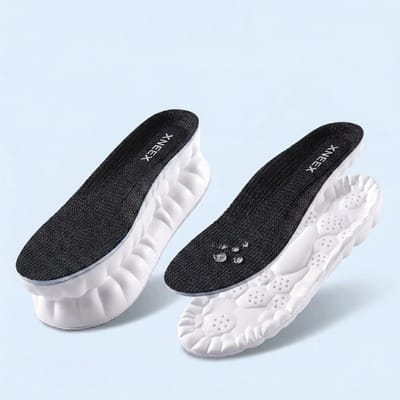
CloudStep insoles combine cushioning and support in every step. The top layer is black and the base is white, and they come as a pair, one for each shoe. They go in place of the original insole, so check that the shoe doesn't feel too tight after the swap.
For more on choosing insoles, read our guide to insoles for standing all day.
Which shoe suits which job?
The type of work changes your priorities. This table helps you know what to focus on.
| Work environment | What matters most in the shoe | What's worth adding |
|---|---|---|
| Kitchens and restaurants | Non-slip sole, an upper that's easy to clean | A cushioned insole for long days |
| Hospitals and healthcare | A light, quiet shoe that's comfortable for many hours | Graduated compression socks for long shifts |
| Retail and counters | Cushioning for standing in place, a wide toe box | An insole and changing position now and then |
| Warehouses and physical work | A stable heel and good grip | An insole that gives a feeling of support |
| Teaching and childcare | Comfort for alternating walking and standing | A second pair to rotate |
Which socks should you wear with work shoes?
A good sock is part of the shoe. It should be breathable, without thick seams, and the right height for the shoe.
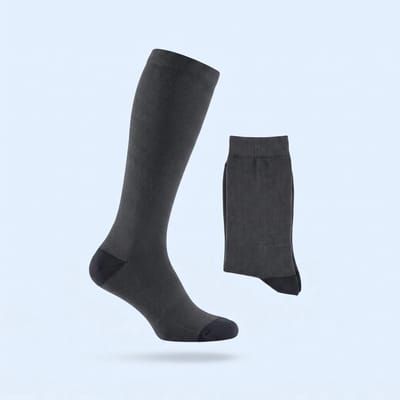
If you stand for many hours, you might consider VeinFlow graduated compression socks. Their compression is 15–20 mmHg, firmer at the ankle and lighter toward the top. They're made of breathable nylon and spandex with a ventilation panel, with a reinforced heel and toe and a wide top band.
- Put them on in the morning, before your legs swell.
- Roll them up from the toes, without wrinkles.
- Take them off before bed.
They're not suitable if you have peripheral artery disease, heart failure, an infection or open wound, or reduced feeling in your legs. If you have diabetes, circulation problems or advanced varicose veins, talk to a doctor first.
How to help your feet get through the shift
Even the best shoe doesn't replace small breaks. A few simple habits make a difference to how you feel at the end of the day.
- Shift your weight from one leg to the other and change position every few minutes.
- If you can, stand on a soft mat rather than directly on concrete or tiles.
- On your break, put your feet up for a few minutes.
- Keep two pairs of work shoes and alternate between them so each pair can air out.
- Replace your shoes when the sole is worn or the cushioning no longer feels like it used to.
At the end of the day, it's worth relaxing your feet with simple stretches at home. You'll find more solutions for long hours of standing in our Feet & Legs collection.
Not sure which product suits your shoes? Email us at hello@getxneex.com – real people will answer.
Frequently asked questions
How do I choose work shoes for standing all day?
Choose a shoe with a wide toe box that lets your toes move, a stable heel that doesn't collapse, a cushioned sole with good grip and a removable insole. Try them on in the afternoon, with your work socks, and check that both shoes are comfortable from the very first moment.
Should I add an insole to my work shoes?
An insole adds a layer of cushioning and support between your foot and the sole, so it's useful when the original insole is thin or worn. Put it in place of the original insole and check that the shoe doesn't become too tight. CloudStep insoles come as a pair, one for each shoe.
When is the best time to try on shoes?
It's best to try on shoes in the afternoon or at the end of the day, when your feet tend to be wider. That way the shoe will still be comfortable in the last hours of your shift. Try on both feet and choose based on the larger one.
Are compression socks suitable if I stand all day?
Graduated compression socks like VeinFlow go on in the morning and come off before bed. They're not suitable if you have peripheral artery disease, heart failure, an open wound or reduced feeling in your legs. If you have diabetes, circulation problems or advanced varicose veins, it's best to talk to a doctor first.
How often should I replace work shoes?
There's no fixed number, because it depends on your working hours and the type of shoe. Signs it's time to replace them are a sole that's worn unevenly, a heel that has softened and collapses, and cushioning that no longer feels like it did at first. Alternating between two pairs lets each pair air out.
More from the Knowledge Center
Insoles for Standing All Day – How to Choose and What to Check →Tired Feet After Standing All Day – The Complete Guide →Foot Stretches at Home: 6 Simple Moves After a Day on Your Feet →All articles →This article is general information and is not a substitute for medical advice.