Knees and Running: What to Do Before, During and After a Run So Your Knee Feels Good

The short answerKnees and running can get along really well when you build the right routine: a short, gradual warm-up before, a comfortable pace and a suitable surface during the run, and cooling down and resting after. Most uncomfortable knee sensations in runners are linked to increasing the load too quickly. Support such as a strap below the kneecap or a knee sleeve can give a feeling of stability, but it doesn't replace building up gradually.
In brief
- Increase distance and pace gradually – big jumps are what the knee feels.
- Warm up with a few minutes of brisk walking and light movements before every run.
- A strap below the kneecap or a knee sleeve gives a feeling of support while running.
- Sharp pain, swelling or limping – stop and get it checked.
Knees and running: why does the knee feel the run first?
When you run, the knee absorbs repeated load with every step, so it's the first to react to changes in your routine. In most cases what it feels isn't the running itself, but too quick a jump in distance, pace or frequency.
The body adapts to load, but muscles and tendons need time. When you add a lot at once, the knee is the one that signals it was too much.
The good news: most of the habits that help your knees when running are simple, and you can start them on your very next run.
What should I do before a run?
Start with a warm-up of a few minutes, and don't head straight out for a fast run from your chair. A warm body handles load more comfortably.
- 3–5 minutes of brisk walking or very slow jogging.
- Dynamic moves: knee lifts, leg swings forward and back, ankle circles.
- A few slow, partial knee bends, without going deep.
- If you run with knee support, this is the time to put it on and adjust it.
It's also worth checking your shoes. A worn sole or a shoe that doesn't suit your foot changes the way your foot lands.
How do I run so my knee feels better?
Run at a pace that lets you talk, with relatively short steps, and progress slowly. It sounds simple, but that's the core of it.
- Short, light steps: an overly long stride that lands far in front of your body increases the load on the knee.
- Surface: dirt trails, grass and running tracks are softer than asphalt. Mix it up.
- Downhills: slow down and shorten your steps on downhills – this is where the knee works especially hard.
- Progress: add distance or pace, not both in the same week.
- Rest: a rest day between runs gives your body time to adapt.
If pain appears during a run and keeps getting worse, stop and walk home. There's no point finishing the route when your body is asking you to stop.
What kind of knee support suits running?
Runners have two common options: a focused strap below the kneecap, or a knee sleeve with even compression. The choice depends on where you feel the strain and what kind of feel you're after.
| Option | What it gives | Especially good when… |
|---|---|---|
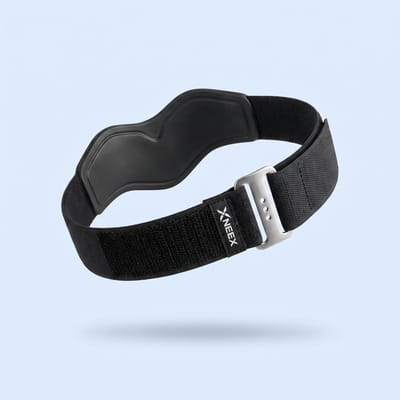
| Below-the-kneecap strap (PatellaBand™) | Focused pressure below the kneecap with a silicone pad | You feel strain below the kneecap and want something slim and light |
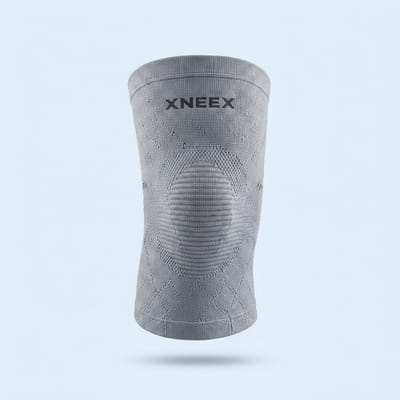
| Bamboo knee sleeve (BambooFlex™) | Graduated, even compression around the whole knee, breathable fabric | You're looking for a general feeling of support and long-lasting comfort |
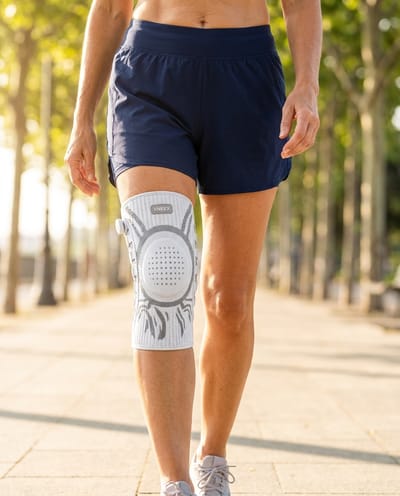
| Smart Knee Support | Stable support with an adjustment dial on the side | You're gradually getting back into running and want more stability |
The PatellaBand™ strap fastens just below the kneecap, with a wave-shaped pad that sits in the center and spreads the load as you move. It fits the right or left knee, in one adjustable size. To learn how to tighten it correctly, read our guide Below-the-Kneecap Strap.
The BambooFlex™ sleeve is sold as a pair, is breathable and suits people who prefer a soft, even feel on both knees.
What should I do after a run?
After a run, slow down gradually, cool down, and let your knee rest. The minutes after matter as much as the minutes before.
- 2–3 minutes of walking before you stop completely.
- Gentle stretches for the front of the thigh, the back of the thigh and the calves.
- Take off the strap or sleeve when resting and sleeping.
- If your knee feels warm and tired, you can cool it for 15–20 minutes with a layer of fabric between the cold and your skin.
And notice how your knee feels the next morning. That's the best indicator of whether the load was right.
What else helps runners' knees between runs?
Strengthening the thigh and hip muscles is one of the most recommended habits for runners. Strong muscles around the knee help it carry the load with every step.
You don't need a gym. Simple exercises at home twice a week are enough to get started:
- Stepping up onto a low step and stepping down slowly and with control.
- Glute bridge, lying on your back.
- Straight leg raise, lying on your side.
- Standing on one leg next to a wall, for balance.
Do the exercises slowly and within a comfortable range. If a particular exercise causes knee pain, skip it and ask a physical therapist what suits you.
When should I ease off?
When the feeling of strain in your knee hasn't gone by your next run, that's a sign to slow down. Reduce distance, add a rest day, or swap one run a week for walking or cycling.
Knees and running get along for years for people who listen to their bodies. There's no need to give it up – just build it at the right pace.
You'll find all the support options in the Knee Pain collection. If you can't decide between a strap and a sleeve, email us at hello@getxneex.com.
Frequently asked questions
Is running bad for your knees?
For most people, running with a load that builds up gradually is an activity the knees adapt to. What's usually felt is too fast an increase in distance or pace. If you have a known knee problem, talk to a doctor or physical therapist before you start.
Strap below the kneecap or knee sleeve – which is better for running?
A strap below the kneecap gives focused pressure and suits you when the strain is felt right below the kneecap. A knee sleeve gives even compression around the whole knee and a general feeling of support. Some runners use a sleeve for long runs and a strap for short workouts.
Should I run with a knee strap all the time?
Wear the strap while running and during activity, and take it off when resting and sleeping. Tighten it for comfortable support, not too tight, and position the pad in the center, below the kneecap. If your toes or leg feel numb, loosen it right away.
Is running on asphalt harder on the knees?
Many people find softer surfaces, like dirt trails, grass or a running track, more pleasant for their knees. There's no need to give up asphalt completely, but it's worth mixing up surfaces and paying special attention on downhills.
What should I do when my knee hurts after a run?
Let your knee rest, you can cool it for 15–20 minutes with a layer of fabric between the cold and your skin, and reduce the load on your next runs. If the pain is sharp, there's swelling that doesn't go away or the pain gets worse, see a doctor or physical therapist.
More from the Knowledge Center
Below-the-kneecap strap: who it's for and how to tighten it correctlyBamboo knee sleeve: when to choose a sleeve and when a knee supportHow to choose a knee support: the complete guide to knee solutionsAll articles →This article is general information and is not a substitute for medical advice.